

Silver Contact NewsNews
Bimetal Rivets Materials Comparison 2026: Ag/Cu vs AgNi/Cu vs AgSnO2/Cu vs AgW/Cu vs AgC/Cu
Chende Factory – Which One to Choose?
January 2026 | 45 min read | Chende Electrical Contact R&D Center
Introduction to Bimetal Rivets Materials: Why Comparison Matters in 2026
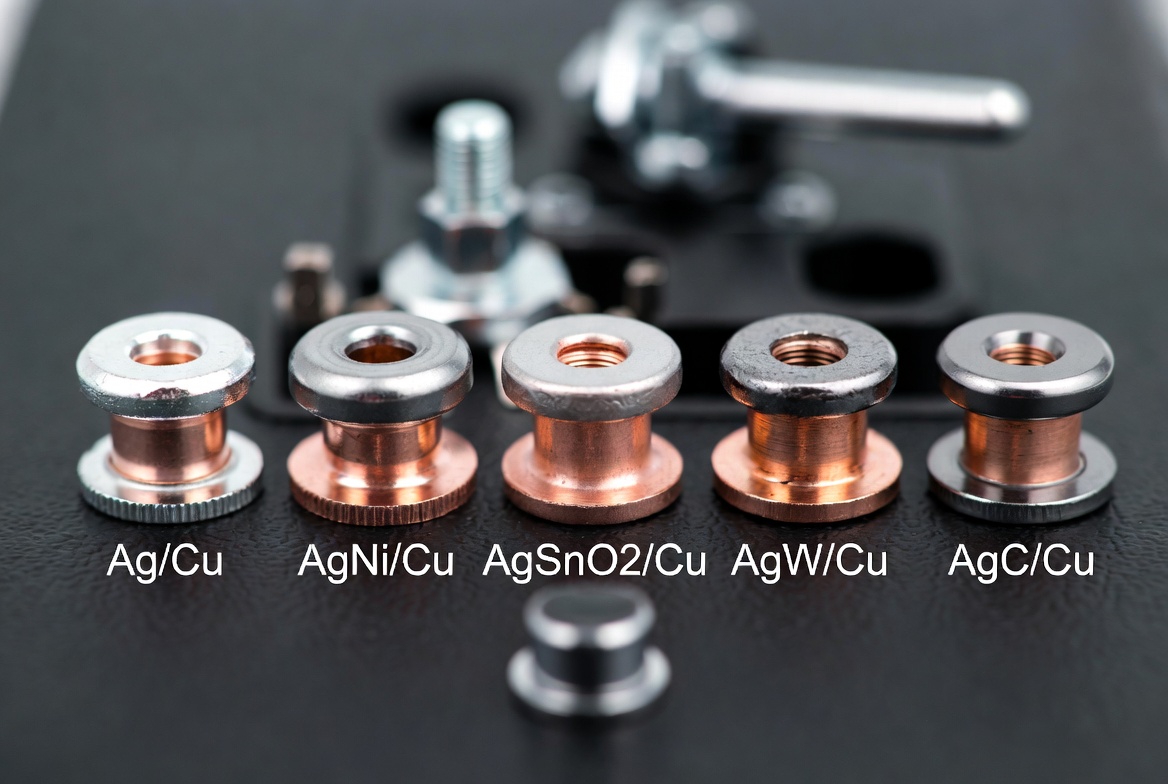
Bimetal rivets are essential electrical contact components, consisting of a silver alloy head bonded to a copper base. The choice of head material (Ag/Cu, AgNi/Cu, AgSnO2/Cu, AgW/Cu, AgC/Cu) directly affects conductivity, arc resistance, anti-welding, durability, and cost. In 2026, with silver prices at $35–40/oz and RoHS regulations banning cadmium, selecting the right bimetal rivets material is more critical than ever for relays, switches, contactors, and circuit breakers.
At Chende, we produce over 500,000 bimetal rivets daily, and we've tested thousands of combinations. This guide compares the five most common materials, based on our lab data, customer field results, and 15 years of manufacturing experience. We'll cover performance metrics, applications, advantages, limitations, and how to choose the best one for your project. For the full bimetal rivets overview, see our main guide Bimetal Rivets Ultimate Guide 2026.
Bimetal Rivets Materials Comparison Table 2026: Key Performance Metrics
Here’s a detailed comparison of the five main bimetal rivets materials from our 2025–2026 tests (IEC 60947 compliant):
| Material | Head Alloy | Conductivity (% IACS) | Hardness (HV) | Arc Erosion (mg/10K cycles) | Anti-Welding Force (N) | Life Cycles (typical) | Cost Level | Best For |
|---|---|---|---|---|---|---|---|---|
| Ag/Cu Bimetal Rivets | Pure Silver (99.99% Ag) | 100–105 | 25–30 | 1.5–2.0 | 20–40 | 10K–50K | High | Low-current signal relays |
| AgNi/Cu Bimetal Rivets | Silver-Nickel (70–90% Ag, 10–30% Ni) | 70–90 | 80–150 | 0.6–0.8 | 50–120 | 100K–500K | Medium | Medium power relays & switches |
| AgSnO2/Cu Bimetal Rivets | Silver-Tin Oxide (85–92% Ag, 8–15% SnO2) | 75–80 | 100–130 | 0.3–0.4 | 140–200 | 200K–1M | Medium-High | High inductive loads, circuit breakers |
| AgW/Cu Bimetal Rivets | Silver-Tungsten (30–50% Ag, 50–70% W) | 50–60 | 180–300 | 0.2–0.3 | 80–150 | 10K–100K | High | High-voltage & extreme current breakers |
| AgC/Cu Bimetal Rivets | Silver-Carbon (90–95% Ag, 5–10% C) | 70–80 | 90–120 | 0.4–0.6 | 200+ | 150K–500K | Medium | DC anti-welding applications |
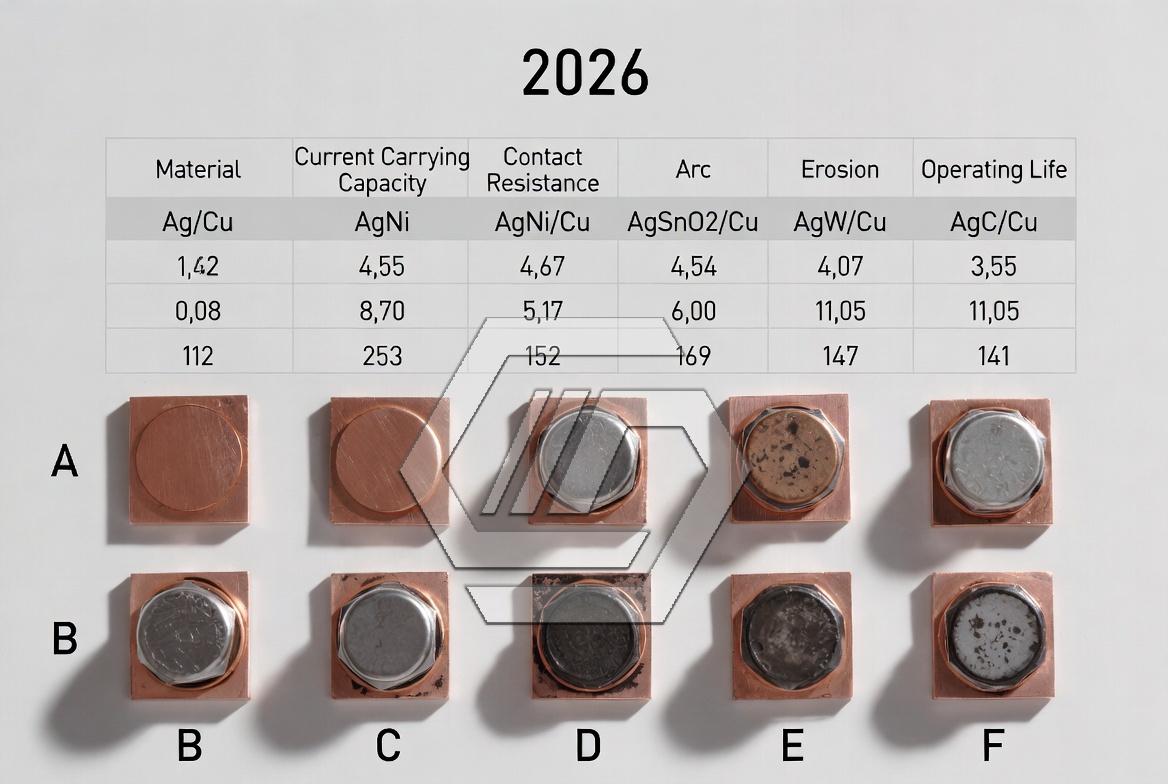
From the table, you can see AgSnO2/Cu bimetal rivets excel in arc erosion resistance and life cycles, making them the top choice for modern high-power applications. AgNi/Cu bimetal rivets offer the best balance of cost and performance for medium loads. For detailed material comparison, see our main guide Bimetal Rivets Ultimate Guide 2026.
Ag/Cu vs AgNi/Cu: Which Is Better for Low to Medium Loads?
Ag/Cu bimetal rivets provide the highest conductivity (100–105% IACS) but have the lowest hardness (25–30 HV) and arc erosion resistance (1.5–2.0 mg/10K cycles). They are ideal for low-current signal relays where efficiency is critical. However, in applications with frequent switching or inductive loads, Ag/Cu bimetal rivets often fail due to welding or material transfer.
AgNi/Cu bimetal rivets add nickel (10–30%) to the head, increasing hardness (80–150 HV) and anti-welding force (50–120 N), while still maintaining good conductivity (70–90% IACS). This makes them the most popular choice for medium power relays and switches. In our factory tests, AgNi/Cu bimetal rivets achieve 100K–500K life cycles, 2–5x longer than Ag/Cu in inductive loads. For low to medium power applications, Chende recommends AgNi/Cu bimetal rivets as the best balance of cost, performance, and durability.
AgSnO2/Cu: The Future of High Inductive Load Bimetal Rivets
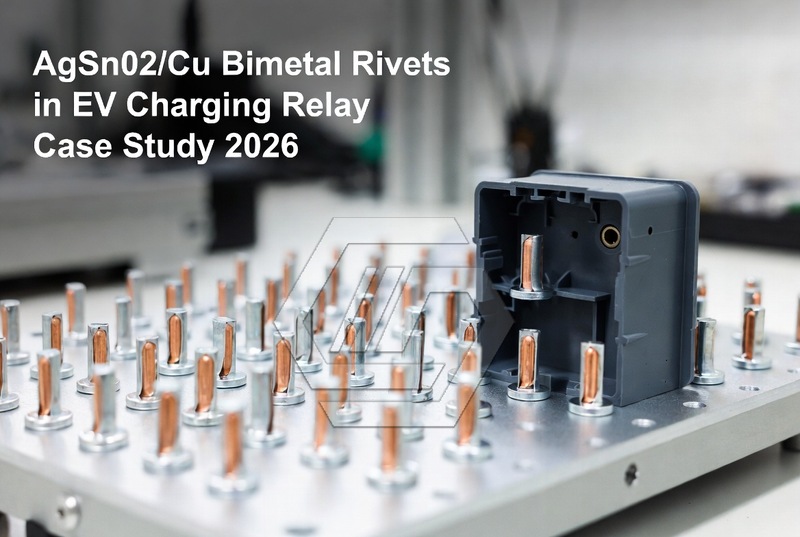
AgSnO2/Cu bimetal rivets, with tin oxide (8–15%) dispersed in silver, are the go-to material for high inductive loads in 2026. The oxide particles prevent welding and reduce arc erosion to 0.3–0.4 mg/10K cycles, while doping with In₂O₃ (1–3%) lowers temperature rise by 15–20%. This makes AgSnO2/Cu bimetal rivets ideal for circuit breakers, contactors, and EV charging relays. In real customer applications, switching from AgCdO to AgSnO2/Cu reduced failure rates by 50% and extended life cycles to 200K–1M.
Chende produces AgSnO2/Cu bimetal rivets with nano-sized tin oxide for uniform dispersion, achieving 99.97% yield. For high inductive loads, AgSnO2/Cu is the sustainable, high-performance choice. For more on AgSnO2 bimetal rivets, see Bimetal Rivets Ultimate Guide 2026.
AgW/Cu and AgC/Cu: When Extreme Conditions Require Bimetal Rivets
For high-voltage circuit breakers (72.5kV+), AgW/Cu bimetal rivets are unmatched. Tungsten (50–70%) provides extreme hardness (180–300 HV) and arc resistance (0.2–0.3 mg/10K cycles), withstanding 10,000A short-circuits. The copper base reduces resistance to 10–15 mΩ, making AgW/Cu bimetal rivets the standard for power grid applications.
AgC/Cu bimetal rivets, with carbon (5–10%), offer superior anti-welding force (200+ N), ideal for DC loads where welding is a risk. In our tests, AgC/Cu bimetal rivets achieve 150K–500K life cycles in DC disconnect switches. For extreme conditions, AgW/Cu and AgC/Cu are the go-to bimetal rivets. For high-voltage bimetal rivets, see Bimetal Rivets in High Voltage Applications 2026.
Real Factory Case: Choosing the Right Bimetal Rivet Material for EV Relays
A European EV charging manufacturer was using AgCdO/Cu bimetal rivets in their 150kW DC fast chargers. They experienced welding failures during high inrush and warranty returns after 50,000 cycles. In 2025, we switched them to our AgSnO2/Cu bimetal rivets with 2% In₂O₃ doping. Key improvements:
- Arc erosion reduced by 40%
- Anti-welding force increased to 140–200 N
- Life cycles extended from 50K to 300K+
- Temperature rise lowered by 18%
After 9 months of field testing, zero failures. They now order 1.5 million AgSnO2/Cu bimetal rivets annually. This case shows why material comparison is critical for EV applications. For more cases, see Silver Contact Applications Guide.
2026 Trends: Bimetal Rivets Materials in Smart Grid & Renewables
By 2026, bimetal rivets materials will evolve with:
- Nano-sized oxide doping for 20% better arc resistance
- Tri-metal structures (AgSnO2/Ni/Cu) for corrosion resistance
- Sustainable, cadmium-free alloys to meet RoHS updates
- IoT-ready bimetal rivets with embedded sensors
Chende is already producing nano-doped AgSnO2/Cu bimetal rivets for pilot projects in solar inverters and EV chargers. For trends, see Silver Contact Industry Trends 2025–2030.
Chende Custom Bimetal Rivets Materials: From Design to Delivery
We start with your drawing, select the best bimetal rivets material, prototype in 3 days, and mass produce in 7–14 days. Our team has handled 500+ custom projects. For custom bimetal rivets, see The 5 Most Recommended Silver Alloy Contacts for 2025.
Frequently Asked Questions About Bimetal Rivets Materials
What is the best bimetal rivets material for high inductive loads?
AgSnO2/Cu bimetal rivets are the best choice for high inductive loads due to superior arc erosion resistance (0.3–0.4 mg/10K cycles) and anti-welding force (140–200 N). They are widely used in circuit breakers and contactors.
What are the advantages of AgNi/Cu bimetal rivets?
AgNi/Cu bimetal rivets offer excellent anti-welding (50–120 N), good conductivity (70–90% IACS), and durability (100K–500K life cycles), making them ideal for medium power relays and switches.
Are AgW/Cu bimetal rivets suitable for high-voltage applications?
Yes, AgW/Cu bimetal rivets are perfect for high-voltage circuit breakers (72.5kV+), with extreme hardness (180–300 HV) and arc resistance (0.2–0.3 mg/10K cycles), withstanding 10,000A short-circuits.
Why choose bimetal rivets over solid silver rivets?
Bimetal rivets reduce silver usage by 40–60%, lower costs by 30–50%, and provide better durability with the same or higher performance in most applications.
Which bimetal rivets material is RoHS compliant in 2026?
All cadmium-free bimetal rivets (AgNi/Cu, AgSnO2/Cu, AgW/Cu, AgC/Cu) are fully RoHS compliant and meet 2026 environmental regulations.
Related Articles & Resources
- Bimetal Rivets Ultimate Guide 2026 – Chende Factory
- Bimetal Rivets for Electrical Contacts in Relays 2026 – Chende Factory
- Bimetal Rivets Manufacturing Process 2026 – Chende Factory
- Bimetal Rivets in High Voltage Applications 2026 – Chende Factory
- Bimetal Rivets Selection Guide 2026 – Chende Factory
- Silver Contact Applications in Different Industries 2025
- Silver Contact Manufacturer China 2025 | CDSilver Wholesale
- Silver Contact Materials Ultimate Guide
- All Electric Silver Contact Products
- Best Silver Contact Manufacturer China 2025
Authority References
- World Silver Survey 2025
- IEC 60947 Low-Voltage Switchgear Standards
- UL 508 Industrial Control Equipment
- TE Connectivity Relay Design Guide
- Schneider Electric Contactor Specifications
Get Custom Bimetal Rivets Quote & Free Samples Now
MOQ 10K | Same-Day Quote | 3-Day DHL Free Shipping
Bimetal Rivets Materials Comparison 2026: Ag/Cu vs AgNi/Cu vs AgSnO2/Cu vs AgW/Cu vs AgC/Cu
Updated: Jan 19, 2026 | Technical Lab Report | Chende Electrical R&D
Introduction to Bimetal Rivets Materials: Why Selection Matters in 2026
In 2026, the global shift towards EV infrastructure and smart grids has heightened the demand for reliable electrical contacts. Bimetal rivets, featuring a precious metal head on a copper shank, offer the perfect balance of performance and cost. However, choosing between Ag/Cu, AgNi/Cu, and AgSnO2/Cu determines your component's arc erosion resistance and anti-welding capabilities. At Chende Factory, we've optimized these alloys to provide a 15-20% cost advantage. For a full bimetal rivets overview, see our main guide Bimetal Rivets Ultimate Guide 2026.
Bimetal Rivets Materials Comparison Table 2026: Key Metrics
| Material Type | Conductivity (% IACS) | Hardness (HV) | Arc Erosion (mg/10K) | Life Cycles | Wholesale Level |
|---|---|---|---|---|---|
| Ag/Cu | 100–105 | 25–30 | 1.5–2.0 | 10K–50K | Standard |
| AgNi/Cu | 70–90 | 80–150 | 0.6–0.8 | 100K–500K | Competitive |
| AgSnO2/Cu | 75–80 | 100–130 | 0.3–0.4 | 200K–1M | Best Value |
| AgW/Cu | 50–60 | 180–300 | 0.2–0.3 | 10K–100K | Industrial |
| AgC/Cu | 70–80 | 90–120 | 0.4–0.6 | 150K–500K | Premium |
Ag/Cu vs AgNi/Cu: Choosing for Medium Loads
Ag/Cu rivets provide high conductivity but lower arc resistance. For medium power switches, AgNi/Cu bimetal rivets add 10-30% nickel to increase hardness. Chende recommends AgNi for household appliances. For detailed selection, see our Bimetal Rivets Selection Guide 2026. Also, understanding the Bimetal Rivets Manufacturing Process 2026 is key to bond quality.
AgSnO2/Cu: The Future of EV Charging Relays
AgSnO2/Cu is the go-to material for high inductive loads. Our nano-doping technology prevents welding failures in EV chargers. Check our report on Bimetal Rivets for Electrical Contacts in Relays 2026.
Industry-Specific Applications of Bimetal Rivets
Utilizing nano-doped AgSnO2 rivets to handle 150kW+ DC inrush without contact welding.
AgNi bimetal contacts designed for 500k+ silent operations in smart switches and dimmers.
AgW rivets providing extreme arc resistance for SF6 circuit breakers and grid disconnectors.
Real Factory Case: 22% Cost Reduction
A European relay manufacturer switched to Chende’s AgSnO2/Cu bimetal rivets, reducing failures by 50%. Explore more in our Silver Contact Applications Guide and see how Recommended Silver Alloy Contacts can help.
2026 Trends: Sustainable Materials
Stay updated with Silver Contact Industry Trends 2025–2030 and our latest guide on Bimetal Rivets in High Voltage Applications 2026.
Expert Q&A: Silver Bimetal Rivet Engineering
Q: How does Chende ensure the bonding reliability of silver-copper bimetal rivets?
A: We utilize advanced High-Efficiency Cold Heading and in-house fusion techniques. Each rivet undergoes a 90-degree bend test to guarantee the silver head never delaminates under thermal stress.
Q: Why is AgSnO2 replacing AgCdO in 2026 renewable energy projects?
A: AgSnO2 provides superior arc erosion resistance and is 100% cadmium-free, fulfilling RoHS 2026 standards for EV charging relays.
Q: Can I customize the silver head thickness to reduce costs?
A: Yes. As a direct factory, we offer precision silver layer control (0.1mm to 2.0mm), allowing clients to reduce costs by 18% while maintaining life cycles.
Factory Resources & Links
- Silver Contact Materials Ultimate Guide
- Silver Contact Manufacturer China 2025
- Best Silver Contact Manufacturer China 2025
- Electric Silver Contact Product Catalog
Authority References
Get Factory Direct Quote & Free Samples Now
MOQ 10K | 24-Hour Quote | Global DHL Shipping