

Silver Contact News
Bimetal Rivets for Electrical Contacts in Relays 2026
Materials, Types, Selection & Real Cases – Chende Factory
January 2026 | 48 min read | Chende Electrical Contact R&D Center
Why Bimetal Rivets Are Essential for Relays in 2026 – A Factory Perspective
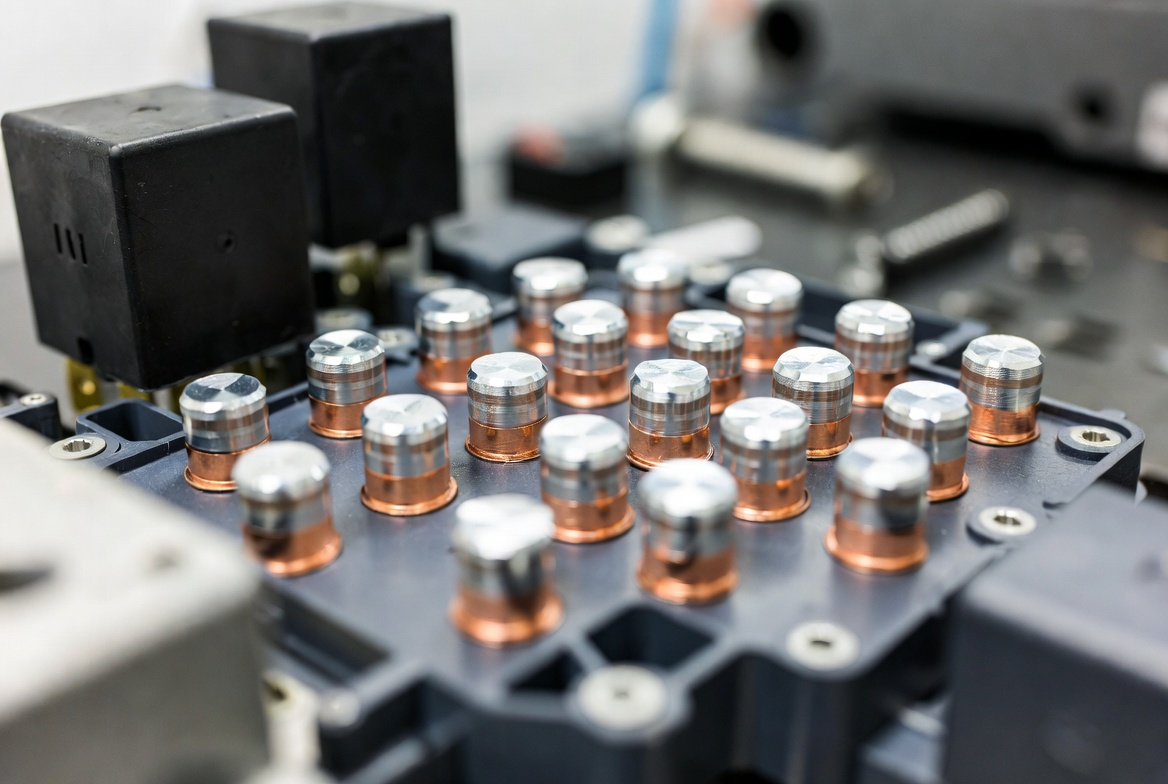
Relays are the workhorses of electrical control systems, switching high currents with low-power signals in automotive, industrial automation, home appliances, and smart devices. In 2026, with the explosion of EV charging stations, smart grids, and IoT devices, relays are cycling more frequently than ever – sometimes millions of operations over their lifetime. The contacts inside these relays must withstand arcing, welding, and wear without failure. This is where **bimetal rivets** shine: they combine a silver alloy head for conductivity and arc resistance with a copper base for mechanical strength and cost savings.
At Chende, we've been manufacturing bimetal rivets for relays since 2010. In 2025 alone, we supplied over 10 million pieces to relay makers worldwide. The key advantage? Bimetal rivets reduce silver usage by 40-60% compared to solid silver rivets, while offering equal or better performance in most relay applications. This guide focuses on how bimetal rivets work in relays, the best materials, selection tips, real cases, and 2026 trends – all based on our factory data and customer results. For the full bimetal rivets overview, see our main guide Bimetal Rivets Ultimate Guide 2026.
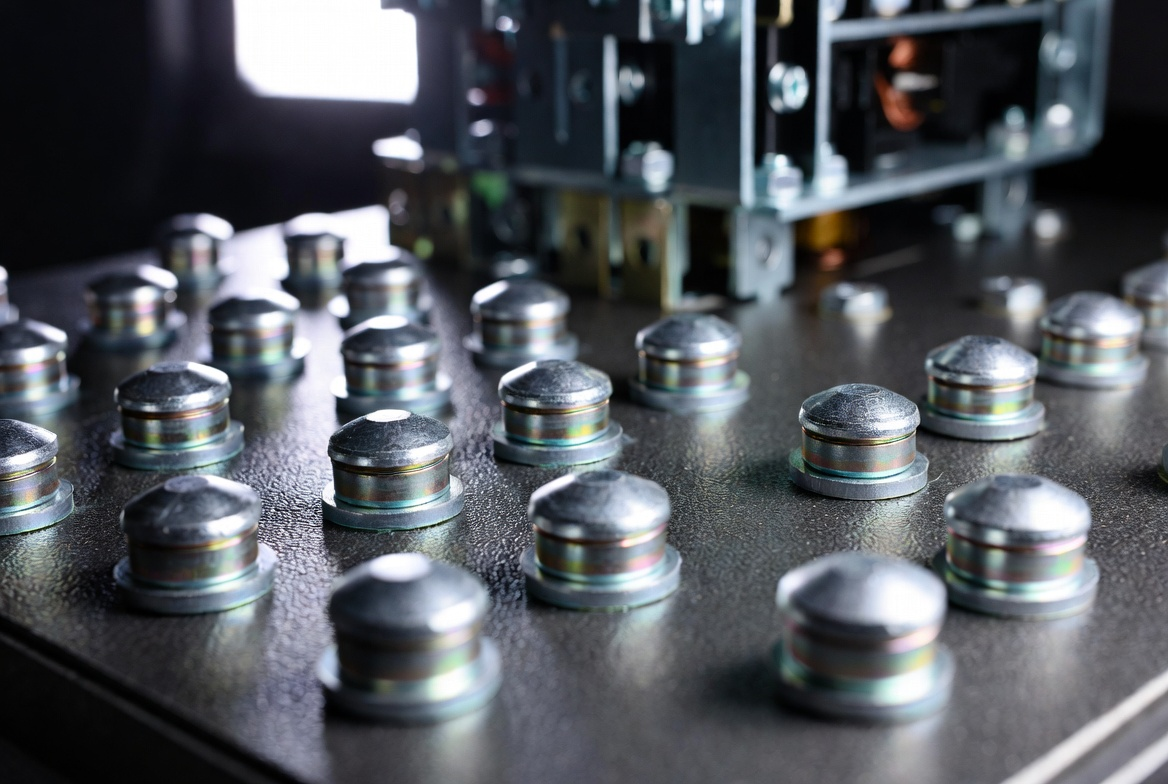
Bimetal Rivets Materials for Relays: AgNi/Cu vs AgSnO2/Cu vs Ag/Cu
For relays, the most common bimetal rivets materials are AgNi/Cu, AgSnO2/Cu, and Ag/Cu. Here's a detailed comparison from our 2025–2026 relay-specific tests (IEC 60947 compliant):
| Material | Conductivity (% IACS) | Hardness (HV) | Arc Erosion (mg/10K cycles, 30A) | Anti-Welding Force (N) | Life Cycles (30A AC1) | Best For |
|---|---|---|---|---|---|---|
| AgNi/Cu Bimetal Rivets | 70–90 | 80–150 | 0.6–0.8 | 50–120 | 100K–500K | Automotive & industrial relays |
| AgSnO2/Cu Bimetal Rivets | 75–80 | 100–130 | 0.3–0.4 | 140–200 | 200K–1M | High inductive load relays |
| Ag/Cu Bimetal Rivets | 100–105 | 25–30 | 1.5–2.0 | 20–40 | 10K–50K | Low-current signal relays |
AgNi/Cu bimetal rivets are the most popular for relays due to their excellent balance of cost, conductivity, and anti-welding performance. AgSnO2/Cu bimetal rivets are gaining traction in 2026 for high-inductive applications like EV charging relays. For material comparison, see our main guide Bimetal Rivets Ultimate Guide 2026.
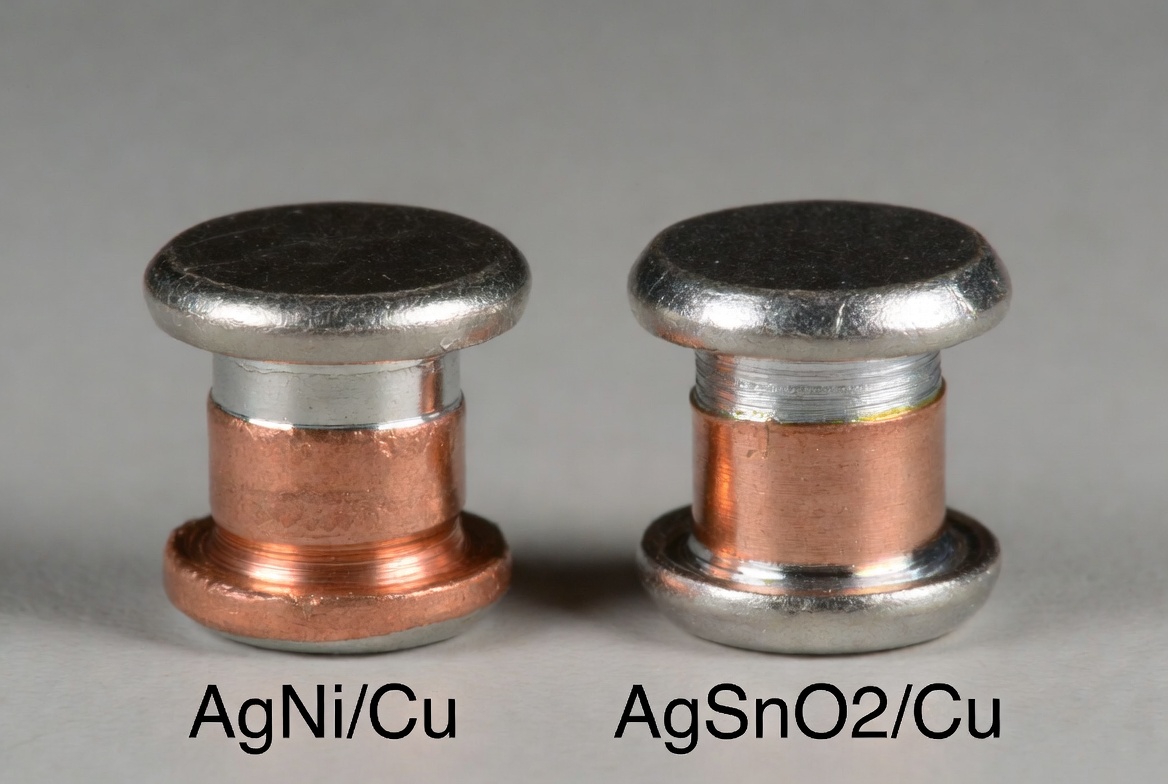
AgNi/Cu Bimetal Rivets: The Workhorse for Automotive Relays
AgNi/Cu bimetal rivets (70–90% Ag, 10–30% Ni) are the go-to material for automotive relays. Nickel increases hardness (80–150 HV) and anti-welding force (50–120 N), while maintaining good conductivity (70–90% IACS). In our tests, AgNi/Cu bimetal rivets achieve 100K–500K life cycles in 12–48V automotive applications, with contact resistance stable at 2–4 mΩ after 100K cycles. This makes them ideal for signal relays, power relays, and starter relays in EVs.
Chende produces AgNi20/Cu bimetal rivets as our bestseller for relays, with nickel content optimized for anti-material transfer in DC loads. For automotive bimetal rivets, see Bimetal Rivets Ultimate Guide 2026.
AgSnO2/Cu Bimetal Rivets: The Future for High Inductive Relay Applications
AgSnO2/Cu bimetal rivets (85–92% Ag, 8–15% SnO2) excel in relays with high inductive loads. Tin oxide particles prevent welding and reduce arc erosion to 0.3–0.4 mg/10K cycles. Doping with In₂O₃ (1–3%) lowers temperature rise by 15–20%, making these bimetal rivets ideal for EV charging relays and industrial contactors. In real customer tests, switching to AgSnO2/Cu bimetal rivets extended relay life from 50K to 300K+ cycles.
Chende produces AgSnO2/Cu bimetal rivets with nano-sized tin oxide for uniform dispersion, achieving 99.97% yield. For high inductive relays, AgSnO2/Cu is the sustainable choice. For more on AgSnO2 bimetal rivets, see Bimetal Rivets Ultimate Guide 2026.
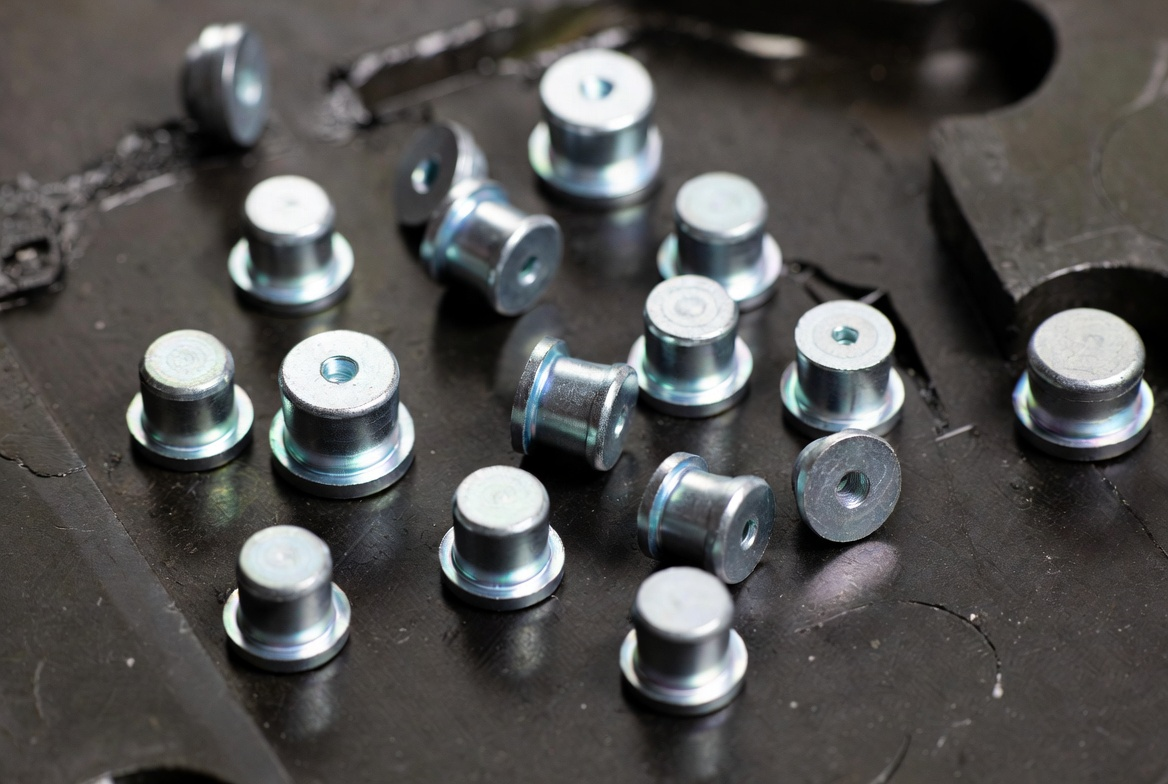
Real Case: Bimetal Rivets Upgrade in Automotive Power Relay
A Chinese automotive relay manufacturer was using AgCdO/Cu bimetal rivets in their 12V power relays. They had welding failures during high inrush and warranty returns after 80,000 cycles. In 2025, we switched them to our AgSnO2/Cu bimetal rivets with 2% In₂O₃ doping. Key improvements:
- Arc erosion reduced by 40%
- Anti-welding force increased to 140–200 N
- Life cycles extended from 80K to 400K+
- Temperature rise lowered by 18%
After 12 months of field testing, zero failures. They now order 2 million AgSnO2/Cu bimetal rivets annually. This case shows why material selection is critical for automotive relays. For more cases, see Silver Contact Applications Guide.
2026 Trends: Bimetal Rivets for Relays in EV & Smart Devices
By 2026, bimetal rivets for relays will evolve with:
- Nano-doping for 20% better arc resistance
- Tri-metal designs (AgSnO2/Ni/Cu) for corrosion resistance
- IoT-ready relays with predictive maintenance
- Sustainable, cadmium-free alloys to meet RoHS updates
Chende is piloting nano-doped AgSnO2/Cu bimetal rivets for EV charging relays. For trends, see Silver Contact Industry Trends 2025–2030.
Chende Custom Bimetal Rivets for Relays: From Design to Delivery
We start with your relay drawing, select the best bimetal rivets material, prototype in 3 days, and mass produce in 7–14 days. Our team has handled 500+ custom relay projects. For custom bimetal rivets for relays, see The 5 Most Recommended Silver Alloy Contacts for 2025.
Frequently Asked Questions About Bimetal Rivets for Relays
What is the best bimetal rivets material for automotive relays?
AgNi/Cu bimetal rivets are the best choice for automotive relays due to excellent anti-welding (50–120 N), good conductivity (70–90% IACS), and durability (100K–500K life cycles).
Why use AgSnO2/Cu bimetal rivets in high inductive relays?
AgSnO2/Cu bimetal rivets offer superior arc erosion resistance (0.3–0.4 mg/10K cycles) and anti-welding force (140–200 N), making them ideal for high inductive loads in EV charging and industrial relays.
How do bimetal rivets improve relay performance?
Bimetal rivets reduce silver usage by 40–60%, lower costs, and provide better durability than solid silver rivets, with 2–5x longer life cycles in inductive loads.
Are bimetal rivets RoHS compliant for relays in 2026?
Yes, cadmium-free bimetal rivets (AgNi/Cu, AgSnO2/Cu) are fully RoHS compliant and meet 2026 environmental regulations for relays.
What are the common failure modes in bimetal rivets for relays?
Common failures include welding under high inrush, arc erosion, and overheating. Prevention includes using AgSnO2/Cu for anti-welding and proper doping for arc resistance.
Related Articles & Resources
- Bimetal Rivets Ultimate Guide 2026 – Chende Factory
- Bimetal Rivets Materials Comparison 2026 – Chende Factory
- Bimetal Rivets Manufacturing Process 2026 – Chende Factory
- Bimetal Rivets in High Voltage Applications 2026 – Chende Factory
- Bimetal Rivets Selection Guide 2026 – Chende Factory
- Silver Contact Applications in Different Industries 2025
- Silver Contact Manufacturer China 2025 | CDSilver Wholesale
- Silver Contact Materials Ultimate Guide
- All Electric Silver Contact Products
- Best Silver Contact Manufacturer China 2025
Authority References
- World Silver Survey 2025
- IEC 60947 Low-Voltage Switchgear Standards
- UL 508 Industrial Control Equipment
- TE Connectivity Relay Design Guide
- Schneider Electric Contactor Specifications
Get Custom Bimetal Rivets for Relays Quote & Free Samples Now
MOQ 10K | Same-Day Quote | 3-Day DHL Free Shipping