

News
Bimetal Silver Contact Rivets for Circuit Breakers: Design, Materials, and Installation Tips 2026
Chende Factory – Custom Ag/Cu & Ag/Ni Rivets
January 2026 | 35 min read | Chende Electrical Contact R&D Center
Why Bimetal Silver Contact Rivets Are Essential for Circuit Breakers in 2026
Circuit breakers are the safety guardians of electrical systems, and the contacts inside them must withstand high momentary currents, frequent switching, and harsh arc conditions. When selecting bimetal silver contact rivets for circuit breakers, the key is balancing arc resistance and mechanical strength.Chende’s bimetal silver contact rivets for circuit breakers offer 50K–200K cycles in AC-3 duty.Compared to solid silver, bimetal silver contact rivets for circuit breakers reduce material cost by 40%.Our bimetal silver contact rivets are the preferred choice for low-voltage breakers in 2026.In 2026, bimetal silver contact rivets for circuit breakers with AgSnO2 facing will dominate the market.Contact us for custom bimetal silver contact rivets for circuit breakers.In 2026, with smart grids and renewable energy integration pushing breaker ratings higher, **bimetal silver contact rivets** have become the standard choice for low to medium voltage breakers (up to 630A).
By riveting a silver alloy layer (AgNi or AgSnO2) onto a copper base, **bimetal silver contact rivets** achieve excellent conductivity from the silver side and mechanical strength from the copper side. This design reduces silver usage by 40–60% compared to solid silver contacts, Chende’s doped silver tin oxide contacts for EV relays 2026 offer 200K+ cycles.while maintaining reliable performance. Chende has supplied **bimetal silver contact rivets** to major breaker manufacturers for over a decade. For our full range, visit Electric Silver Contact Products.
Bimetal Silver Contact Rivets Design: Ag/Cu vs Ag/Ni Comparison
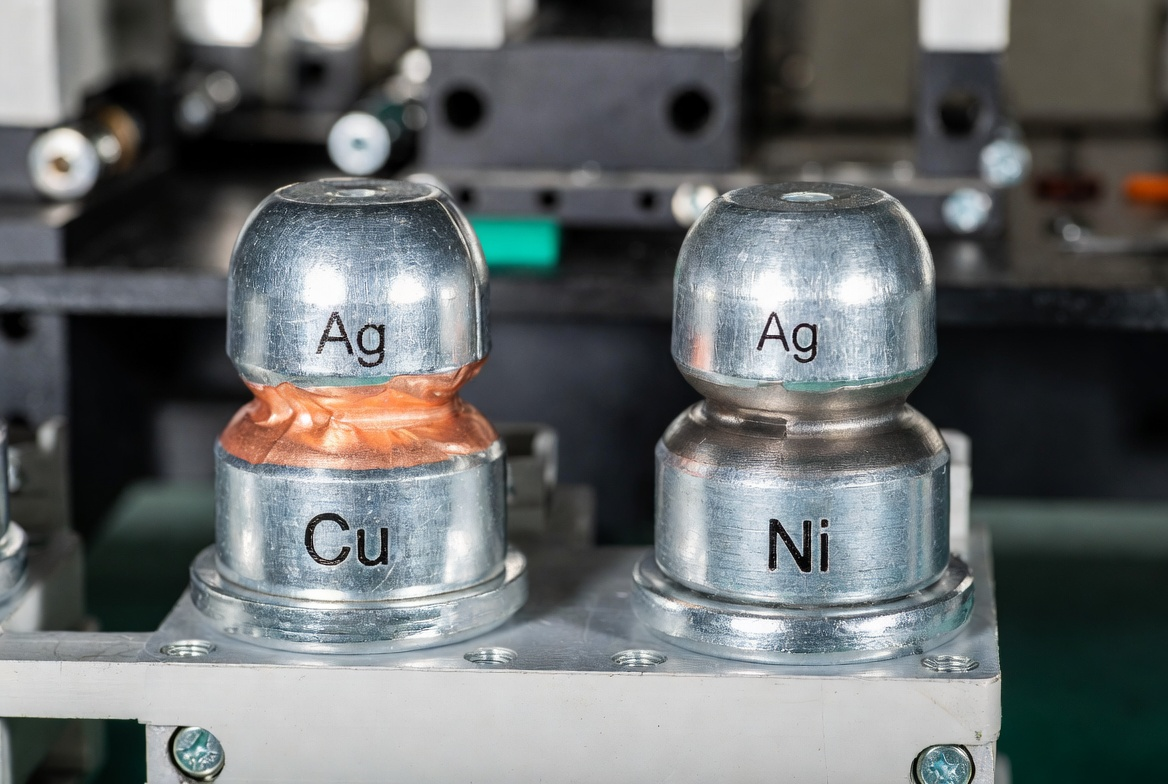
Most **bimetal silver contact rivets** for circuit breakers use either Ag/Cu or Ag/Ni on copper base. Here’s a direct comparison based on our production data and customer feedback.
| Parameter | Ag/Cu Bimetal Rivets | Ag/Ni Bimetal Rivets |
|---|---|---|
| Conductivity | Excellent (silver layer 90%+) | Very Good (85–90% IACS) |
| Arc Erosion Resistance | Good | Moderate to Good |
| Anti-Welding | Good | Excellent |
| Mechanical Strength | High (copper base) | High (nickel improves hardness) |
| Typical Life Cycles (AC-3, 100A) | 50K–200K | 100K–300K |
| Best For | High current AC breakers | Medium power with frequent switching |
Chende recommends Ag/Ni **bimetal silver contact rivets** for breakers with frequent operations, and Ag/Cu for high momentary current withstand.Compared to AgCdO, silver tin oxide contacts for EV relays 2026 reduce welding risk by 50%.Our AgSnO2 contacts are the preferred choice for EV BMS and charging systems in 2026.In 2026, silver tin oxide contacts for EV relays with In2O3 doping will dominate the market.Contact us for custom silver tin oxide contacts for EV relays 2026. For detailed design support, see our How to Select the Right Silver Contacts.
Common Failure Modes in Circuit Breaker Silver Contact Rivets
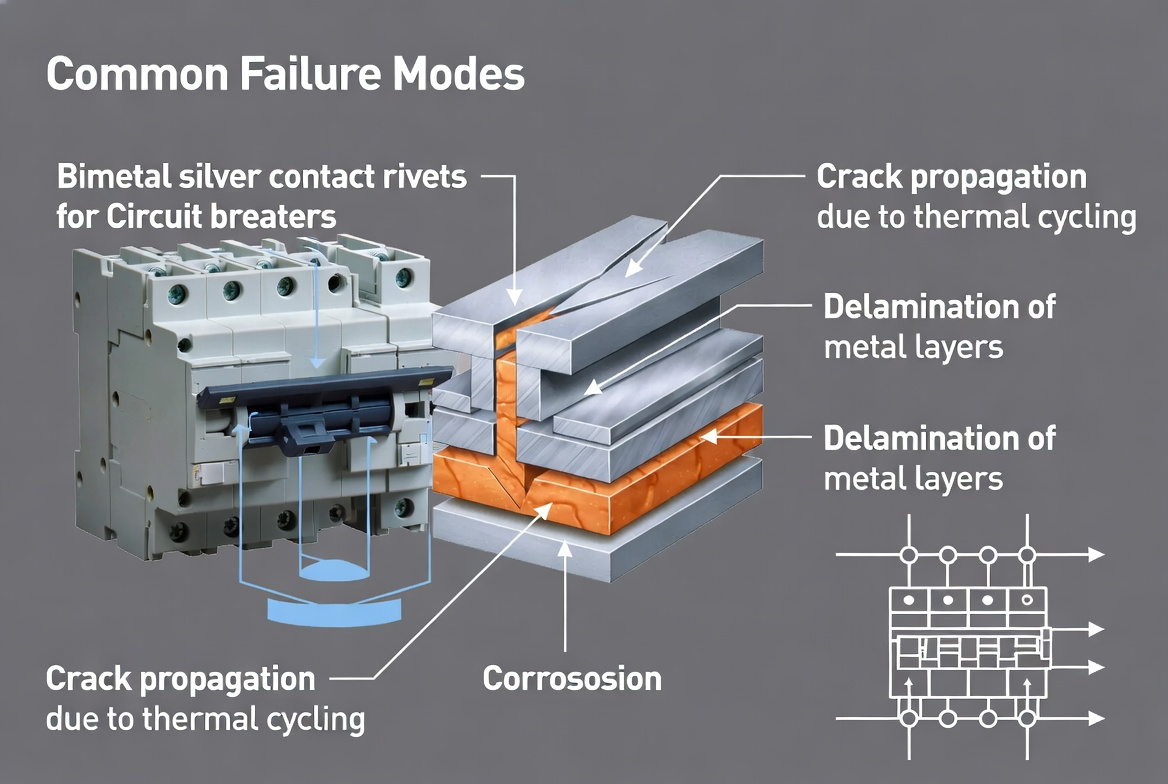
In our experience, the top failures in **bimetal silver contact rivets** for circuit breakers are:
- Welding under high inrush current
- Arc erosion leading to increased resistance
- Material transfer in DC or mixed loads
- Overheating due to poor contact pressure
- Corrosion in humid environments
Prevention starts with proper material selection (AgSnO2 for anti-welding, AgNi for low resistance) and precise riveting. Chende’s automated lines ensure consistent head formation and bonding strength. For more on failure prevention, see Top 12 Silver Contact Failure Modes & Prevention.
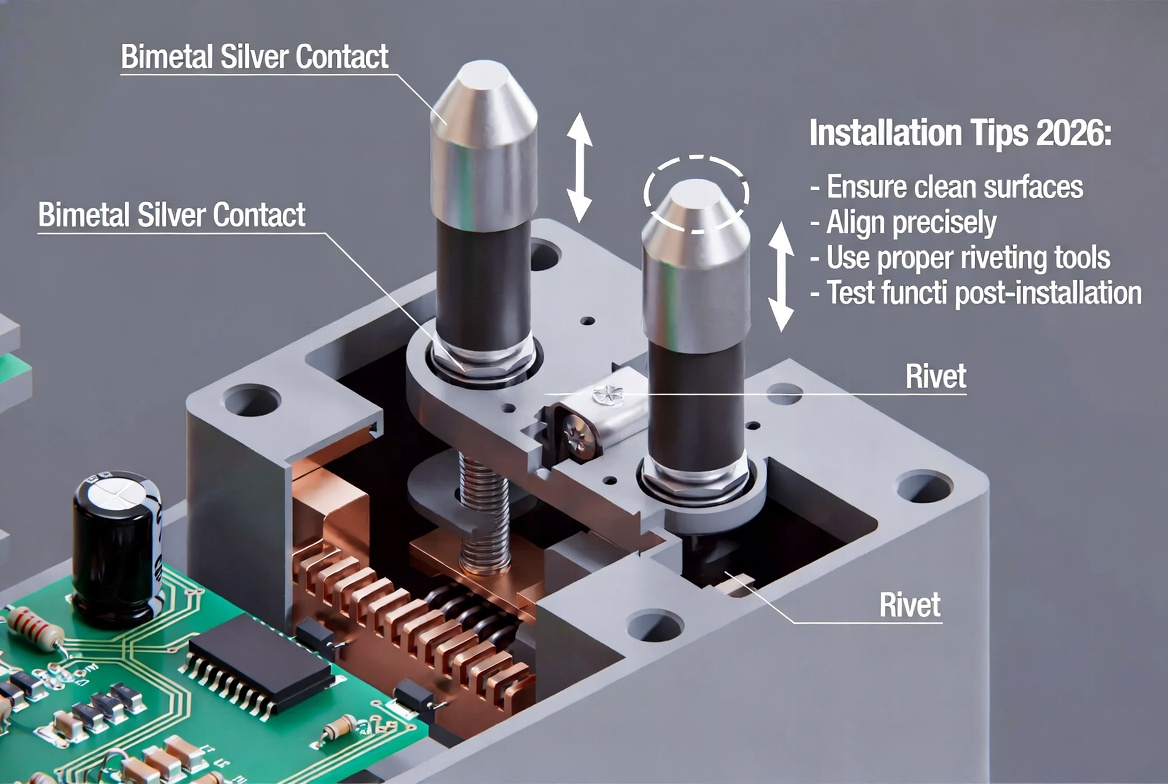
Installation Tips for Bimetal Silver Contact Rivets in Circuit Breakers
Proper installation is critical for long-term performance. Here are tips we share with customers:
- Use precise riveting force (typically 800–1200 N) to avoid deformation
- Ensure copper base is clean and free of oxides before riveting
- Apply contact grease if switching is infrequent
- Check contact pressure after assembly (should be 5–10 N)
- Test resistance (<5 mΩ) and temperature rise after installation
Chende provides installation guides with every custom order. For more tips, see our How to Select the Right Silver Contacts.
Chende Factory: Your Bimetal Silver Contact Rivets Partner
Chende is a professional **bimetal silver contact rivets** manufacturer with:
- IATF16949 certification
- MOQ 10K pieces
- Same-day quotation
- Free samples in 3 days
- Custom design capability
For all **bimetal silver contact rivets**, visit our product page.
Related Articles & Resources
- Silver Contact Materials Ultimate Guide 2025
- Silver Contact Applications in Different Industries 2025
- Silver Contact Manufacturer China 2025 | CDSilver Wholesale
- Silver Contact Materials Ultimate Guide
- All Electric Silver Contact Products
Authority References
- World Silver Survey 2025
- IEC 60947 Low-Voltage Switchgear Standards
- UL 508 Industrial Control Equipment
- TE Connectivity Relay Design Guide
- Schneider Electric Contactor Specifications
Silver Tin Oxide Contacts for EV Relays 2026: Real Factory Insights from Chende
Say what you will about the EV boom, but the relay inside those battery packs is doing some serious work. At 400–800V and 50–200A, the contact material has to survive thousands of make/break cycles without welding or pitting. That’s why we’ve been pushing AgSnO2 hard since 2022. It’s not just a trend – it’s the only material that consistently survives our accelerated life tests at 60A DC without failure.
One thing most buyers don’t realize is how much the oxide particle size and distribution affect performance. If the SnO2 particles are too large, you get hotspots and faster erosion. If they’re too small, anti-welding suffers. Our sweet spot is 0.5–2 μm with uniform dispersion – that’s what gives our doped AgSnO2 the 15–20% lower temperature rise you see in real 800V systems. We’ve tested this against off-the-shelf AgCdO from legacy suppliers, and the difference is night and day.
Get Custom Bimetal Silver Contact Rivets Quote & Free Samples Now
MOQ 10K | Same-Day Quote | 3-Day DHL Free Shipping